
AEO vs SEO in 2026: What Is Answer Engine Optimization and Why It Matters
Author
Muhammad Awais
Published
May 21, 2026
Reading Time
13 min read
Views
24.1k

Something significant shifted in search in 2025 and it has only accelerated into 2026. Google AI Overviews now appear in roughly 15% of all search results. When they do, organic click-through rates on the top-ranking link drop by an average of 34.5%. Users are getting direct answers inside the search results page and clicking through to websites less often. SEO practitioners are calling this "The Great Decoupling" visibility is rising while traffic is falling at the same time. Understanding what Answer Engine Optimization is, how it differs from what you already know, and what actually works in this environment is no longer a nice-to-have. It is the SEO strategy conversation of 2026.
What Is Answer Engine Optimization (AEO)?
Answer Engine Optimization is the practice of structuring your content and site signals so that AI-powered answer systems Google AI Overviews, ChatGPT search, Perplexity, Google AI Mode, and voice assistants can identify your site as a reliable source worth citing, surfacing, or summarizing in their responses.
The distinction from traditional SEO is subtle but important. Traditional SEO optimizes for a position in a list of links. AEO optimizes for inclusion in an answer that may not include a link at all. You are not just competing for rank. You are competing to be the source an AI system trusts enough to reference when it constructs a response to a user query. In some cases the user will click through to you. In others, your content informs the answer without generating any traffic to your site whatsoever.
This is not a replacement for traditional SEO. The brands performing best in AEO in 2026 are almost always the same brands with strong existing SEO foundations. Technical health, crawlability, backlink authority, and topical relevance are still the infrastructure layer. AEO is what you build on top of that foundation a layer of content structure, clarity, and citation-friendliness that AI systems specifically reward.
AEO, GEO, and the Alphabet Soup of AI Search in 2026
The AI search optimization space has generated several overlapping terms that are worth understanding clearly before diving into tactics.
AEO (Answer Engine Optimization) specifically targets direct answer environments the kind of response where a user asks a specific question and an AI gives a definitive answer. Featured snippets, Google AI Overviews for factual queries, and voice search responses all fall under this umbrella. The goal is to be the source the AI extracts its answer from.
GEO (Generative Engine Optimization) is broader. It targets the longer, synthesized responses that generative AI tools produce the kind where Perplexity or ChatGPT writes three paragraphs explaining a topic and cites multiple sources. GEO optimizes for being mentioned, referenced, or included in those generated explanations. Research from 2025 found that brands are 6.5 times more likely to be cited in AI responses through third-party sources than through their own domain, which means GEO heavily rewards being a credible, widely-referenced entity in your space.
Traditional SEO remains the foundation for both. Without solid technical SEO fast page speeds, clean crawlability, structured data, and genuine authority neither AEO nor GEO tactics will get far. Think of SEO as the plumbing, AEO as the faucet, and GEO as knowing which rooms the water reaches.
The Numbers Behind the Shift You Need to Know
Before getting into tactics, let's establish what the data actually shows so you can calibrate how seriously to take this shift.
Google AI Overviews appear in approximately 15% of all searches as of May 2026 up from nearly zero in early 2024. That percentage is growing every month.
When AI Overviews appear, organic click-through rates on the first result drop by an average of 34.5%. Some studies measuring specific query categories put the drop higher than 50% for informational queries.
Despite the drop in clicks, Google search usage actually increased the average user now conducts 12.6 search sessions per week after adopting ChatGPT, up from lower baseline levels. People are searching more, but clicking less.
Brands are 6.5 times more likely to be cited by AI tools through third-party mentions (news coverage, forum discussions, citation-heavy content) than through their own first-party pages.
Non-Google AI platforms ChatGPT, Perplexity, Gemini are now capturing a meaningful share of the informational query volume that used to flow exclusively through traditional search. Analysts project that AI platform referral traffic will surpass traditional search referral traffic sometime between 2027 and 2028 at current growth rates.
The practical implication is that measuring SEO success through sessions and clicks alone in 2026 tells an incomplete story. Impressions, brand citations in AI responses, and direct referral traffic from AI platforms are now metrics worth tracking alongside traditional ranking data.
What Traditional SEO Still Does Well
Before the AEO section, it is worth being direct about what traditional SEO still controls, because this context prevents overcorrection.
Commercial intent queries product comparisons, service searches, local business searches are still primarily resolved through traditional blue-link results. When someone searches "best project management software for small teams" they are in buying mode, not answer mode. AI Overviews appear less frequently on transactional queries and users in that mode click through to compare options. For e-commerce, SaaS, and local businesses, traditional SEO remains the primary traffic driver.
Technical SEO signals site speed, Core Web Vitals, mobile performance, clean crawl paths, and structured data implementation are also more critical than ever because AI crawlers use many of the same signals as traditional crawlers to assess quality and credibility. A technically broken site does not rank in AI results any more than it ranks in traditional results.
Brand building and link authority have not lost value either. In fact, the GEO finding that third-party citations drive AI inclusion at 6.5x the rate of self-owned content makes off-page authority arguably more important than it has been in years. The mechanism has shifted from PageRank signal to AI trustworthiness signal, but the underlying behavior that earns it being cited by credible external sources is the same.
🤖 Generate AI-Ready Content Prompts — Free Tool
How to Actually Optimize for AI Answer Engines
Here is what AEO work looks like in practice. These are not theoretical SEO principles these are the specific content and technical behaviors that make AI systems more confident in citing your content.
1. Answer the Question Directly, in the First Paragraph
AI extraction systems look for the most direct, self-contained answer to a query. Content that buries its answer behind three paragraphs of preamble does not get extracted the AI moves to a source that answers the question in the first two sentences. Structure every key section of your content so that the heading is the question and the first paragraph below it directly answers that question. Everything that follows can be context, depth, and supporting detail. But the direct answer must come first.
2. Use Structured Data Everywhere It Applies
Schema markup is the most direct signal you can give AI crawlers about what your content is and what questions it answers. The schema types with the highest AEO impact right now are FAQPage (for question-and-answer content), HowTo (for step-by-step guides), Article with explicit datePublished and dateModified, and BreadcrumbList for topic hierarchy signaling.
If your site runs on Next.js, injecting JSON-LD structured data is straightforward add it to the page's metadata export and it is included in the rendered HTML on both server and client. For developers building or maintaining content-heavy Next.js sites, we keep an updated breakdown of structured data tooling and what the best developer tooling stack looks like for this kind of work in our guide on top React and Next.js developer tools for 2026.
3. Build Topical Authority Over Keyword Targeting
AI systems assess content credibility at the topic level, not the keyword level. A site with fifteen deeply useful, interconnected articles about a specific topic will be treated as more trustworthy than a site with one highly optimized page targeting a single high-volume keyword. Build content clusters a main pillar page on a topic, supported by satellite pages that explore subtopics in depth, all internally linked to each other. This topical depth signals to both Google and AI systems that your site understands a domain rather than just targeting a term.
4. Write for Clarity Over Cleverness
AI models are trained to extract reliable information from text. Metaphor-heavy intros, vague claim language, and buzzword-dense writing are harder for AI to parse and therefore less likely to be cited. Sentences should be short and declarative. Claims should be specific and either cited or clearly identifiable as your own analysis. Avoid vague qualifiers like "some experts believe" without identifying who or citing a source. The content that AI systems pull from most frequently is the content that reads cleanest the kind a reader could clip one sentence from and immediately understand what it means without context.
5. Optimize for Freshness on Evolving Topics
AI systems heavily weight recency for topics that are actively evolving technology, business, policy, health. If you have existing content that ranks well but has a stale publish date, update it with a clear dateModified in your structured data, refresh the statistics and examples, and add a brief note at the top noting the update. Google AI Overviews and Perplexity both show preference for recently updated, authoritative content on fast-moving topics. This is not about faking freshness it is about genuinely keeping your best content current and signaling that clearly in your metadata.
The Technical SEO Layer That Supports AEO
AEO content strategy works best when it sits on a technically sound foundation. The specific technical factors that correlate most strongly with AI inclusion in 2026 are Core Web Vitals performance (particularly Largest Contentful Paint under 2.5 seconds), clean JavaScript rendering that does not hide content from crawlers, HTTPS with no mixed content, and canonical URL consistency across your site.
For Next.js developers, this means using server-side rendering or static generation for content pages rather than client-only rendering, keeping your JavaScript bundle sizes lean, and ensuring your metadata, structured data, and Open Graph tags are all server-rendered in the HTML response. These are the same improvements that benefit traditional SEO, which reinforces why the technical foundation and the AEO layer are not in conflict they compound each other. If you are modernizing an existing codebase to meet these standards, the decisions involved are covered in depth in our guide on modernizing your tech stack with TypeScript and Tailwind.
Measuring Success Differently in the AI Search Era
If your site gets 30% fewer clicks on a page that now appears in AI Overviews, that is not necessarily a loss. The visibility that comes from being the cited source in an AI answer builds brand trust at scale users see your brand name as the authority even when they don't click. Over time this brand recognition drives direct searches, newsletter signups, and conversion-intent visits that convert at higher rates than cold organic clicks.
The measurement framework worth building in 2026 tracks impressions and AI citation rate alongside traditional sessions and conversions. Tools like Google Search Console still capture impression data. For AI citation tracking specifically, tools like Perplexity's built-in source attribution, manual spot-checking by querying your target topics in AI platforms, and emerging third-party AI visibility trackers give you signal on how your content is being referenced. This is a newer measurement category and the tooling is still maturing, but monitoring it even manually gives you information that pure GA4 data misses entirely. And since good content structure and AI tools now go hand in hand in content creation workflows, building content with this dual audience in mind human readers and AI extractors is what the best-performing content teams are doing right now. It is the same clarity-first principle that makes AI-assisted content and coding workflows produce better outputs when your prompts and structures are precise.
Frequently Asked Questions
What is the difference between AEO and SEO?
Traditional SEO optimizes content to rank in a list of search results so users click through to your site. AEO (Answer Engine Optimization) optimizes content to be cited, summarized, or extracted by AI answer systems like Google AI Overviews, Perplexity, and ChatGPT often without the user needing to click at all. AEO is not a replacement for SEO but an additional layer built on top of a solid SEO foundation.
What is "The Great Decoupling" in SEO?
The Great Decoupling refers to the growing gap between impressions and clicks in search. In 2026, many pages are getting more Google impressions because they appear in AI Overviews and AI-enhanced search results, but fewer actual clicks because users get the answer directly from the AI summary without visiting the page. Sites that previously measured success only by traffic are experiencing apparent declines even while their actual visibility and brand reach are increasing.
What is GEO and how is it different from AEO?
GEO stands for Generative Engine Optimization. AEO targets direct answer environments where an AI gives a single clear answer to a specific question. GEO targets longer generative responses where AI tools like ChatGPT or Perplexity synthesize information from multiple sources into a paragraph-length explanation. GEO optimization focuses on being cited or referenced in those longer AI-generated summaries, while AEO focuses on being the primary source for a direct factual answer.
Does Google AI Overviews reduce website traffic?
Yes, for informational queries it measurably does. Studies show organic click-through rates drop by an average of 34.5% when Google AI Overviews appear on a results page. However, the impact varies significantly by query type. Transactional queries where users are comparing products or looking for a service provider are far less affected than informational queries where users just want a quick factual answer. The net traffic effect for any site depends on what types of queries it ranks for.
How do I optimize my content for Google AI Overviews?
The most effective tactics are: answer the query directly in the first paragraph without preamble, use FAQPage and Article schema markup, write in clear declarative sentences with specific claims rather than vague language, build topical authority through content clusters rather than isolated pages, keep content fresh and update dateModified in your structured data, and ensure your technical SEO is solid so AI crawlers can access your content cleanly. Pages that are already ranking well in traditional search are more likely to be included in AI Overviews, which makes traditional SEO performance the most reliable path to AEO inclusion.
Tagged in
Continue Reading
All Articles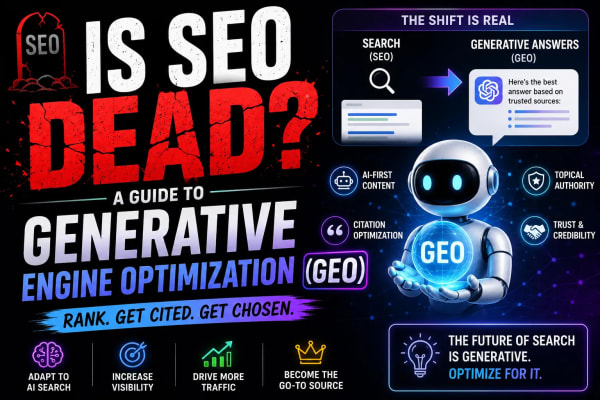


Level Up Your Workflow
Free tools mentioned in this article
HTTP Status Code Lookup
Look up any HTTP status code instantly 1xx to 5xx, Cloudflare codes, WebDAV, with JS/Next.js handling examples. Free, no signup.
HTML to JSX / TSX Converter
Instantly convert HTML code to React JSX or TSX components. Automatically handles className, style objects, SVGs, and self-closing tags with secure, in-browser processing.
Unix Timestamp Converter
Convert Unix timestamps to readable dates and back instantly. View the current epoch time, convert any timestamp, and see results in any timezone.
SVG Path Builder & Visualizer
An interactive, client-side SVG path builder and visualizer tool. Generate optimized cubic and quadratic Bezier vector code instantly on a grid canvas.