
Modernizing Your Tech Stack: A Comprehensive Guide to TypeScript and Tailwind CSS
Author
WebToolsHub Editorial
Published
May 8, 2026
Reading Time
5 min read
Views
290
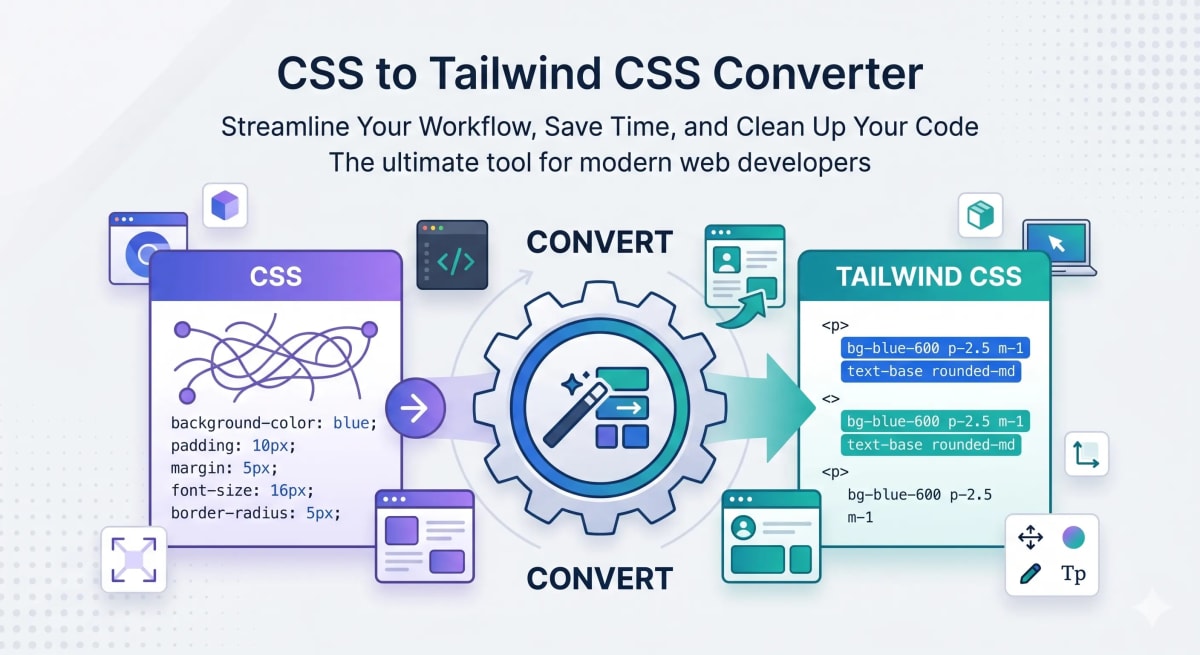
Modern web development in 2026 is no longer just about writing code; it's about building scalable, high-performance ecosystems that can grow with your user base without collapsing under technical debt. As projects expand from simple prototypes to complex enterprise applications, two major challenges inevitably surface: managing complex state/logic and maintaining consistent styling across teams. Failure to address these early leads to what developers call "Legacy Debt," where adding a single feature takes weeks instead of hours.
The Case for TypeScript: Why Static Typing is Non-Negotiable
If you're still writing vanilla JavaScript for large-scale applications, you're essentially building a skyscraper on a foundation of sand. In the early stages of development, JavaScript's flexibility feels like a superpower—you can move fast and break things. However, as the codebase grows to thousands of lines, that same flexibility becomes a liability. Runtime errors like undefined is not a function or cannot read property of null become common occurrences in production, frustrating users and damaging your brand's reputation.
TypeScript provides the structural integrity needed to catch these bugs before they ever reach a single user. By introducing strict types, interfaces, and compile-time checks, you turn runtime disasters into simple development-time fixes. It changes the developer experience from "guesswork" to "certainty." With TypeScript, your IDE becomes a co-pilot, providing intelligent autocompletion and instant documentation for every object and function in your system.
Many developers hesitate to switch because of the perceived overhead of rewriting legacy code or manually creating complex interfaces for large API responses. That's exactly why we built our JSON to TypeScript Converter. It allows you to instantly generate type-safe interfaces from any JSON payload, cutting down migration time from hours to mere seconds. This tool is the perfect "entry drug" for moving your legacy JavaScript project into a robust, type-safe future.
Tailwind CSS: The Future of Atomic and Scalable Styling
Traditional CSS files are a maintenance nightmare that grows exponentially with every new component. For decades, we tried to solve this with methodologies like BEM (Block Element Modifier) or SASS nesting, but the core problems remained: specificity wars, naming collisions, and ever-growing bundle sizes. Every time you add a new CSS rule to a 5,000-line stylesheet, you're potentially breaking a layout on a page you haven't checked in months.
Tailwind CSS solves this by providing a set of low-level, atomic utility classes. Instead of writing custom CSS, you compose your design directly in your markup. This approach has three massive benefits:
- No More Render-Blocking Stylesheets: Every byte of CSS you ship is actually used. Because Tailwind's compiler (JIT) only generates the classes you use, your final CSS bundle remains tiny—often under 10KB even for massive sites.
- Design System in a Box: Tailwind enforces a strict scale for colors, spacing, and typography. This ensures that your "blue-500" on the login page is the exact same blue as on the dashboard, creating a professional and consistent user experience.
- Zero Side Effects: Since styles are scoped to the element, changing the margin on a button in your footer will never accidentally break the header.
The performance results are undeniable. Google PageSpeed Insights loves utility-first CSS because it eliminates unused code and reduces the "First Contentful Paint" (FCP) significantly. If you're looking to modernize your existing, bloated stylesheets, our latest tool is the perfect starting point.
Ready to ditch your bloated CSS?
Don't let legacy code slow down your growth. Convert your legacy stylesheets to modern Tailwind utility classes in seconds with our high-performance converter.
Open CSS to Tailwind ConverterTechnical Debt: The Silent Killer of Startups
Technical debt is like a high-interest credit card. You can use it to build features quickly today, but if you don't pay it back, the interest payments (bugs, slow performance, developer burnout) will eventually bankrupt your project. Migrating to TypeScript and Tailwind CSS is the ultimate "debt repayment" strategy. It simplifies your codebase, makes it self-documenting, and ensures that new developers can join the team and start contributing on day one without fearing the "spaghetti code."
The Synergy of Modern Tools and Automation
At WebToolsHub, we believe that the best workflow is one where humans focus on creativity and logic, while machines handle the tedious parts of refactoring. Our philosophy is rooted in automation. Why manually map CSS properties to utility classes or manually write interfaces for a 100-field JSON response when a tool can do it perfectly in milliseconds? By using our suite of utilities, you can automate the most boring and error-prone parts of technical debt management. Our mission is to provide you with the "Expert's Toolkit"—tools that don't just solve a problem, but teach you the best practices of the modern web while they do it.
The long-term value of your software is determined by its ability to change. Projects that use static typing and utility styling are inherently more adaptable. When Google updates its Core Web Vitals or a client asks for a complete rebrand, projects built on TypeScript and Tailwind CSS can pivot in days, while legacy projects often require a total rewrite. This agility is what separates successful platforms from those that fade into obscurity.
Conclusion: Building for the Next Billion Users
The web is becoming more competitive every day. Users have zero tolerance for slow-loading pages or buggy interfaces. Modernizing your tech stack isn't about following the latest hype; it's about survival. By combining the type safety of TypeScript with the performance and consistency of Tailwind CSS, you are building an application that is ready for the global stage.
Take the first step today. Refactor one component. Convert one JSON response. Use our tools to bridge the gap between where your project is now and where it needs to be. For more insights on how to optimize your development workflow, don't forget to check out our Full Blog Archive.
Tagged in
Continue Reading
All Articles

Level Up Your Workflow
Free tools mentioned in this article
LLM API Cost Calculator
Compare LLM API pricing across 18 models GPT-4o, Claude Sonnet 4, Gemini 2.5 Pro, DeepSeek, Mistral and more. Calculate monthly API costs, count tokens live, and convert to 7 currencies. Free, instant, no signup.
Stripe & PayPal Fee Calculator
Calculate the exact Stripe and PayPal transaction fees for US and UK markets. A free developer tool to estimate SaaS payouts, merchant costs, and revenues.
Tailwind Class Sorter
Sort Tailwind CSS classes instantly using Prettier's official order. Paste plain classes, HTML, or JSX get clean, sorted output in one click. Free, no signup.
Cron Job Expression Generator & Explainer
Generate cron expressions visually and instantly translate any cron schedule into plain English. Includes GitHub Actions, Vercel, and AWS presets.