
Is SEO Dead? A Guide to Generative Engine Optimization (GEO)
Author
Muhammad Awais
Published
May 19, 2026
Reading Time
4 min read
Views
114.5k
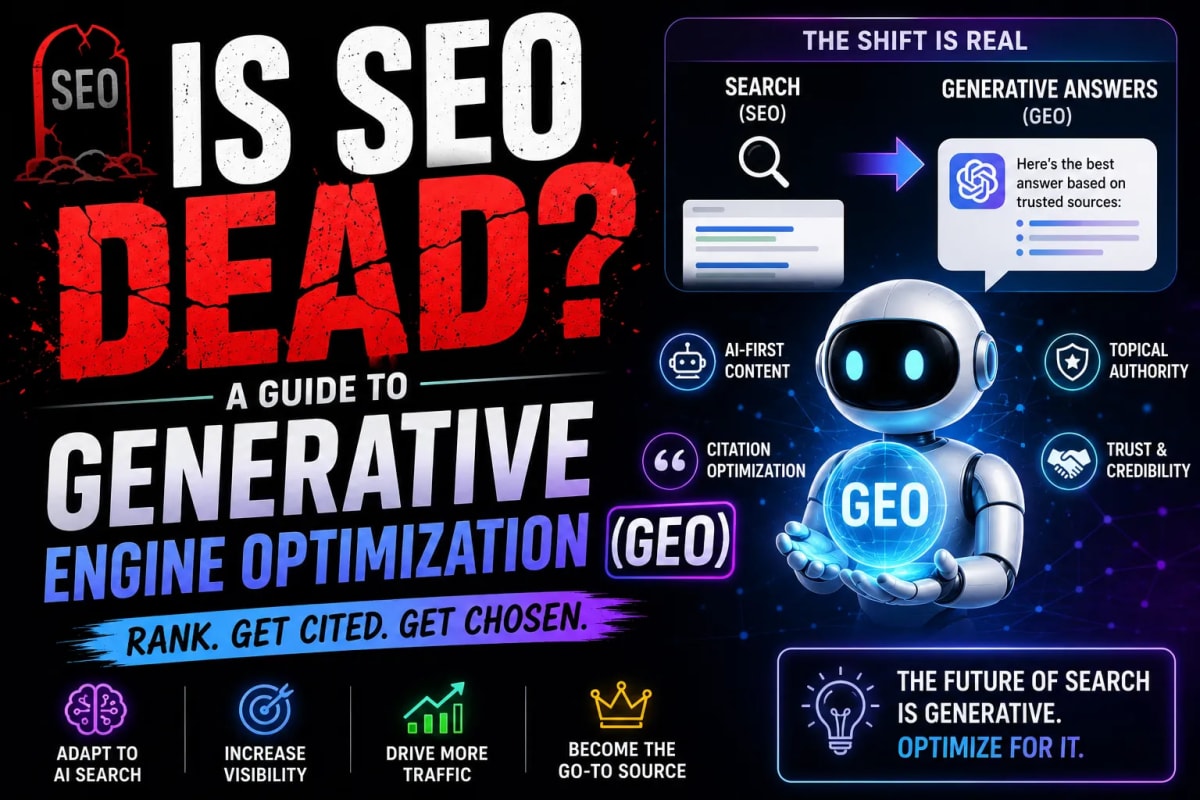
Every time a massive algorithm update rolls out, marketers panic and ask the same question: Is SEO dead? For decades, the answer was always no. But in 2026, traditional Search Engine Optimization as we knew it—stuffed keywords, manipulated backlinks, and ten blue links—is finally fading. The digital world has shifted toward AI-driven search experiences like Google's AI Overviews, Perplexity, and ChatGPT. To survive this transition, you must evolve from traditional SEO to Generative Engine Optimization (GEO).
1. GEO vs SEO: What is the Difference?
Traditional SEO focused on pleasing web crawlers by placing exact-match keywords in H1 tags and accumulating domain authority. You were optimizing for a database index. Generative Engine Optimization, on the other hand, means optimizing your content to be cited as a trusted source by Large Language Models (LLMs).
When a user asks an AI a question, the model does not just look for keywords; it looks for factual density, unique statistics, and structured reasoning. If your article is just a 2,000-word fluff piece repeating what is already on Wikipedia, the AI will ignore it. To rank in AI search, your content must provide new, highly structured value that the model can confidently summarize and cite.
🤖 Master AI Communication: Try Our Free AI Prompt Optimizer2. How to Rank in AI Search (The GEO Playbook)
So, how do you actually practice GEO? Researchers have tested thousands of queries against generative engines to find out what makes them pick one source over another. Here are the three most powerful GEO strategies:
- Cite Authoritative Statistics: AI models love numbers. If you say "Many people use AI," the model ignores it. If you say "In 2026, 78% of B2B marketers use AI workflows," the model is highly likely to extract and cite your sentence.
- Fluency and Formatting: LLMs prefer content that is easy to parse. Use clear bullet points, bold text for key terms, and markdown tables. Avoid massive walls of unstructured text.
- Direct Expert Quotes: AI engines are specifically trained to look for authoritative opinions to back up their summaries. Include quotes from industry experts in your niche.
The Role of Programmatic Content in GEO
As generative engines consume vast amounts of data, having a massive library of structured, niche-specific pages increases the mathematical probability of your brand being cited. By utilizing automated development frameworks, you can generate thousands of highly structured, data-rich pages that AI models love to ingest. If you want to deploy this strategy, read our technical breakdown on Programmatic SEO: Generating 10,000 Pages in Next.js.
3. Technical Optimization for the AI Era
Even if your content is perfect for LLMs, traditional technical rules still apply. An AI crawler like OpenAI-Bot or Google-Extended cannot read your site if it takes 10 seconds to load or throws rendering errors. Technical hygiene is the prerequisite to GEO.
You must ensure that your Core Web Vitals are flawless and your images are modern and lightweight. A slow site gets skipped by AI crawlers just as fast as it gets skipped by human users. Start by permanently switching your visual assets to next-gen formats by reading our guide: Why Legacy Images Are Killing Your SEO.
The Verdict
Is traditional SEO dead? Mostly, yes. The era of gaming the system with keyword density is over. But search itself is not dead; it has just evolved. By embracing Generative Engine Optimization, structuring your data clearly, and focusing on high-density factual value, your website can dominate the AI-generated answers of tomorrow.
Frequently Asked Questions
What does GEO stand for in marketing?
GEO stands for Generative Engine Optimization. It is the process of optimizing website content so that AI search engines (like ChatGPT, Gemini, or Perplexity) confidently cite and recommend your website in their generative answers.
Is SEO completely dead in 2026?
Traditional 'hacky' SEO is dead, but technical optimization and content strategy are more important than ever. The focus has simply shifted from ranking on a list of blue links to becoming a trusted source cited by AI models.
How do I optimize for ChatGPT?
To optimize for LLMs, you must provide unique statistics, clear markdown formatting (tables, bullet points), expert quotes, and concise, factual answers to specific questions.
Tagged in
Continue Reading
All Articles

Level Up Your Workflow
Free tools mentioned in this article
Unix Timestamp Converter
Convert Unix timestamps to readable dates and back instantly. View the current epoch time, convert any timestamp, and see results in any timezone.
Shadcn Theme Generator
Visually generate and preview Shadcn UI themes. Customize HEX to HSL colors, enforce flat design, and instantly copy globals.css and tailwind.config.ts code.
CSS to Tailwind CSS Converter
Convert legacy CSS to modern Tailwind CSS utility classes instantly. 100% secure, free, and runs entirely in your browser. Boost your core web vitals today.
SQL Query Validator
Validate and format SQL queries instantly MySQL, PostgreSQL, SQLite & SQL Server. Free online SQL query checker with detailed error messages. No signup needed.