
TanStack Start vs Next.js 2026: Which React Framework Should You Actually Use?
Author
Muhammad Awais
Published
May 30, 2026
Reading Time
11 min read
Views
22.2k
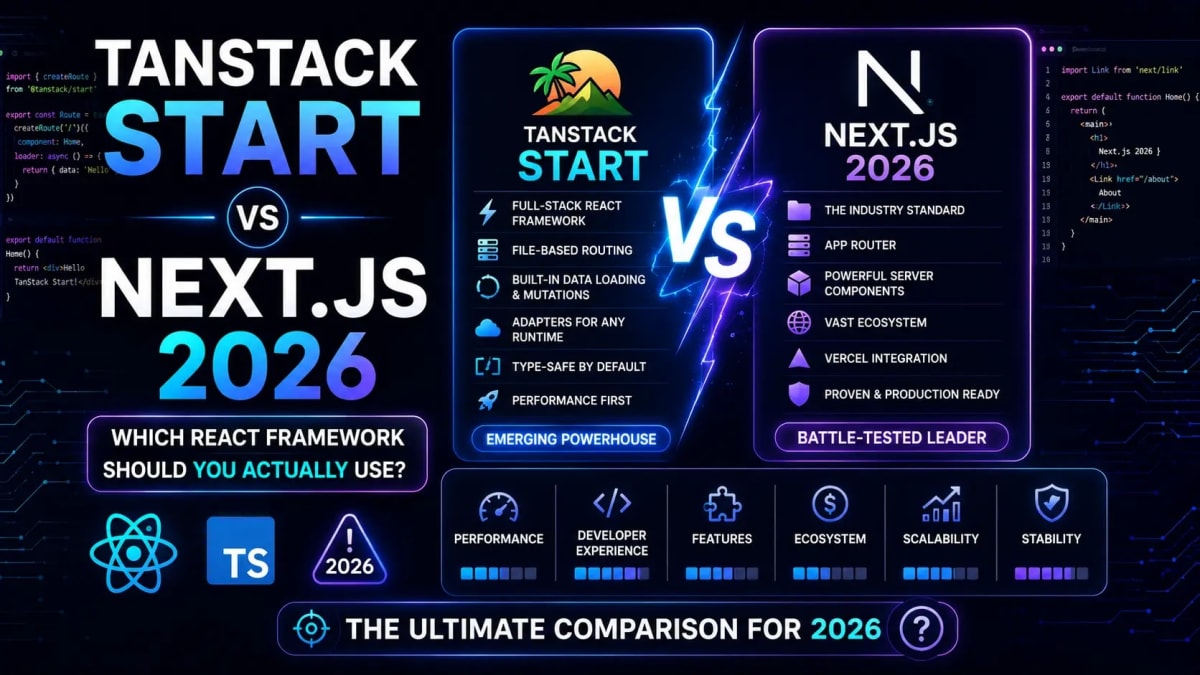
You start a new project. You open your terminal and type npx create-next-app because that's just what you do, right? That's what I did for three years straight without thinking twice. Then in early 2026, a teammate sent me a GitHub link and said "try this for the dashboard we're building." It was a TanStack Start repo. Two weeks later, I was questioning every Next.js decision I'd made in the past year.
This is not a "Next.js is dead" article. I still ship Next.js apps and recommend it in specific situations. But if you haven't looked at TanStack Start vs Next.js seriously in 2026, you're making framework decisions based on outdated information. The gap has closed and in some areas, TanStack Start has pulled ahead.
What TanStack Start actually is and how it's built
Where TanStack Start genuinely wins over Next.js
Where Next.js still holds the advantage
A real comparison table so you can make the decision fast
The exact question I ask myself before starting any new React project in 2026
What Is TanStack Start - And Why It Matters Now
TanStack Start is a full-stack React framework built by Tanner Linsley the same developer behind TanStack Query (formerly React Query), TanStack Table, and TanStack Router. It uses Vinxi (a Vite-based server framework) as its build engine and Nitro as its server runtime.
If those names don't mean much yet, the practical summary is: it's fast, it's modern, and it's built on tools that experienced developers already trust. TanStack Start reached its stable 1.x release in early 2026 and now sits at nearly 6 million weekly npm downloads. That's not a hobby project anymore that's production-grade.
The core philosophy is different from Next.js in one critical way: TanStack Start is additive. You opt into server-side capabilities when you need them. Next.js App Router is RSC-first the architecture assumes server-rendered components by default, and you fight it when you need heavy client interactivity.
That single difference explains most of the developer experience gap I'll describe below. Now let's get into the actual comparison.
TypeScript Developer Experience: TanStack Start Wins Clearly
Honestly, this is where the gap is most obvious and most impactful for day-to-day development. TanStack Start's end-to-end TypeScript type safety isn't just better than Next.js. It's a different category of experience.
In Next.js, when you do router.push("/dashboard/123"), you're pushing a string. TypeScript cannot validate it. There are community packages that help, but it's bolt-on tooling not built-in. Rename a route in a large Next.js codebase and you're running a find-and-replace hoping you didn't miss anything.
In TanStack Start, routes are type-safe by default:
// TypeScript knows every route that exists
// Autocomplete works, typos caught at compile time
navigate({ to: "/dashboard/$userId", params: { userId: user.id } });
Route params, loader data, search params, and server function inputs/outputs are all typed automatically without manual effort. Refactor a route and TypeScript tells you everything that broke. That's the kind of type safety that actually saves hours in production debugging, not just in theory.
Use our JSON to TypeScript converter when you're mapping API responses to TypeScript interfaces in either framework it cuts the boilerplate significantly.
Routing Architecture: Different Philosophies, Different Use Cases
Next.js App Router uses file-based routing with RSC-first architecture. Every file in the /app directory is a Server Component by default. You add "use client" when you need interactivity. This is great for content-heavy sites blogs, e-commerce, marketing pages where minimizing client JS is the goal.
TanStack Router (the routing layer in TanStack Start) uses a code-based approach with type-safe route definitions. You define routes explicitly, loaders run on the server, and client-side interactivity is the default not the exception.
I spent two weeks last year wrestling with "use client" boundaries on a dashboard project that was 80% interactive widgets. Every component that needed state had to be a Client Component, but its parent wanted to be a Server Component, and the data-fetching story got complicated fast. That exact project is where TanStack Start's model would have saved me real time.
Project Type | Better Choice | Why |
|---|---|---|
Blog / Content site | Next.js | RSC-first = minimal client JS by default |
SaaS Dashboard | TanStack Start | Heavy interactivity fits additive model better |
E-commerce | Next.js | Native Payload/CMS integrations, ISR support |
Internal Admin Tool | TanStack Start | Type-safe routing + TanStack Query = perfect fit |
Marketing + App hybrid | Next.js | Larger ecosystem, more third-party integrations |
Real-time App | TanStack Start | Client-first model doesn't fight real-time patterns |
Performance and Build Speed: TanStack Start Has a Real Edge
This surprised me the most. One team benchmarked both frameworks against a live SaaS system in early 2026 and the numbers were significant. Local startup time dropped from 10-12 seconds to 2-3 seconds after switching to TanStack Start. Root HMR went from 836ms to 335ms. Production builds in CI were 7x faster.
The reason isn't magic it's Vite. TanStack Start uses Vite as its build system. Next.js historically used webpack (and now Turbopack, which has improved things). Vite's module resolution and HMR are simply faster for most project types, especially during development.
There's also a memory story. Next.js development server memory can climb to 9-10GB locally on large projects. One team reported frequent OOMKilled pods under load in production. TanStack Start's footprint is considerably smaller. For teams running tight infrastructure budgets, that matters.
If you're optimizing Core Web Vitals after the switch, our guide on fixing Core Web Vitals in 2026 covers the INP, LCP, and CLS improvements that apply to both frameworks.
Ecosystem and Integrations: Next.js Still Wins
I'm not going to sugarcoat this Next.js has a massive ecosystem advantage that isn't going away in 2026. Years of community packages, tutorials, third-party integrations, and enterprise adoption mean that almost any problem you hit in Next.js has a documented solution.
TanStack Start's ecosystem is growing fast, but gaps exist. The most notable one is CMS integration. If you're using Payload CMS, for example, the native Next.js integration is straightforward. Running Payload alongside TanStack Start requires a monorepo setup Payload in a separate Next.js app, TanStack Start consuming it as an API. That's architecturally reasonable but meaningfully higher overhead.
Vercel's deployment platform is also deeply optimized for Next.js. Edge functions, ISR, image optimization, analytics all of it works better when you're deploying a Next.js app to Vercel. TanStack Start deploys fine to Vercel, Cloudflare Workers, and other platforms, but you won't get the same level of native optimization.
For authentication, error tracking, payments, and most SaaS infrastructure Next.js has more direct integrations available today. If you're building quickly and need to plug in services fast, Next.js is still faster to bootstrap.
When to Use TanStack Start vs Next.js: The Decision Framework
After building production apps with both frameworks in 2026, here's the mental model I use when starting a new project:
Choose TanStack Start when:
You're building a dashboard, SaaS product, admin panel, or internal tool where 60%+ of the UI is interactive
TypeScript type safety across routes and data loaders is a priority for your team
You're already using TanStack Query in a Next.js project (migration is smoother)
Build speed and dev server performance are bottlenecks on your current setup
You want framework-agnostic primitives you can carry across projects
Choose Next.js when:
You're building a content-heavy site where minimizing client JavaScript is critical
Your team needs RSC for performance at scale with mostly static or server-rendered pages
You need deep Vercel platform integration (ISR, edge middleware, image CDN)
You're integrating with CMS platforms like Payload, Contentful, or Sanity natively
You're hiring developers who know Next.js but not TanStack — onboarding time matters
Need to decode a JWT token while building auth in either framework? Our jwt decoder and verifier tool runs entirely in your browser no data sent to a server.
Real Migration Story: Pages Router → App Router vs Next.js → TanStack Start
Most developers I talk to in 2026 are either mid-migration from Next.js Pages Router to App Router, or considering whether TanStack Start is worth the switch entirely. These are actually related decisions.
If you're still on Pages Router and haven't started your App Router migration: stop and evaluate TanStack Start first. The migration effort to App Router is significant you're relearning data fetching patterns, component boundaries, and server/client split. You could put that same effort into TanStack Start and end up with a codebase that's more TypeScript-safe and faster to build.
Our Next.js Pages Router to App Router migration guide covers this decision in detail if you're already committed to staying in the Next.js ecosystem.
If you're already on App Router and things are working: don't migrate just because TanStack Start is trending. Rewrite cost is real. The time to consider TanStack Start is on your next greenfield project, not mid-sprint on a working codebase.
Frequently Asked Questions
Is TanStack Start production-ready in 2026?
Yes, TanStack Start reached its stable 1.x release in 2026 and is built on TanStack Router, which has been production-proven across thousands of projects for years. It's currently at nearly 6 million weekly npm downloads. Teams are shipping real SaaS products, dashboards, and internal tools with it. The ecosystem is smaller than Next.js but stable enough for most production use cases especially data-driven applications and dashboards.
What is the biggest difference between TanStack Start and Next.js?
The core difference is architectural philosophy. Next.js App Router is RSC-first every component defaults to server-rendered, and you opt into client interactivity with "use client". TanStack Start is additive client-side interactivity is the default, and you opt into server-side rendering per route when you need it. For content sites, Next.js's model is cleaner. For interactive dashboards and SaaS products, TanStack Start's model fits more naturally and avoids fighting the framework's defaults.
Does TanStack Start support SSR and Server-Side Rendering?
Yes, TanStack Start supports full server-side rendering, streaming, and static generation. It uses Vinxi under the hood for server rendering. The model differs from Next.js React Server Components TanStack Start uses loaders and server functions rather than RSC but the end result (HTML delivered from the server) is equivalent. The performance characteristics are comparable for most use cases, with TanStack Start often having faster development builds thanks to Vite.
Can I use TanStack Query with TanStack Start?
Yes, and this is one of TanStack Start's biggest practical advantages. TanStack Query is a first-class citizen in the TanStack ecosystem. The integration between TanStack Router loaders and TanStack Query's caching and invalidation model is seamless. If you're already using TanStack Query in a Next.js project, migrating to TanStack Start for your next project will feel natural you're just removing the mismatch between the two systems.
Should I migrate my existing Next.js app to TanStack Start?
Probably not mid-project. The rewrite cost is real, and if your Next.js app is working well, the business value of migration is hard to justify. The better time to adopt TanStack Start is on a new greenfield project especially if it's a dashboard, admin panel, or SaaS product. For developers still on Next.js Pages Router who haven't migrated to App Router yet, TanStack Start is worth evaluating seriously before committing to the App Router migration path, since both require significant effort.
Is TanStack Start faster than Next.js?
In development, yes often significantly. TanStack Start's Vite-based build system delivers faster HMR, faster cold starts, and lower memory usage during development compared to Next.js (even with Turbopack). In production, performance depends heavily on what you're building. Content sites with heavy server rendering may favor Next.js's RSC model for minimal client JS. Interactive applications typically see comparable or better performance with TanStack Start, especially when combined with TanStack Query's intelligent caching.
Are all WebToolsHub tools free to use?
Yes. every tool on WebToolsHub is completely free, requires no account or sign-up, and runs entirely in your browser. No data is ever sent to a server. Whether you're using the JWT decoder, JSON to TypeScript converter, or regex tester, everything processes client-side on your machine.
Tagged in
Continue Reading
All Articles

Level Up Your Workflow
Free tools mentioned in this article
Tailwind SVG Background Pattern Generator
The ultimate visual builder for Dot Grids, Plus Signs, and geometric SVG background patterns. Generate optimized Tailwind CSS classes for your SaaS landing pages.
Sitemap Validator
Free XML sitemap validator & checker check sitemap.xml syntax, broken URLs, duplicates & bad lastmod dates. Health score, CSV export. No signup needed.
Unix Timestamp Converter
Convert Unix timestamps to readable dates and back instantly. View the current epoch time, convert any timestamp, and see results in any timezone.
PX to EM Converter
Convert pixels to em and em to px with customizable parent font size. Free, instant, local calculation, copy-ready CSS snippets & Tailwind classes.