
Next.js 14 Server Actions Security: Prevent CSRF & Leaks
Author
Muhammad Awais
Published
May 17, 2026
Reading Time
6 min read
Views
10.6k
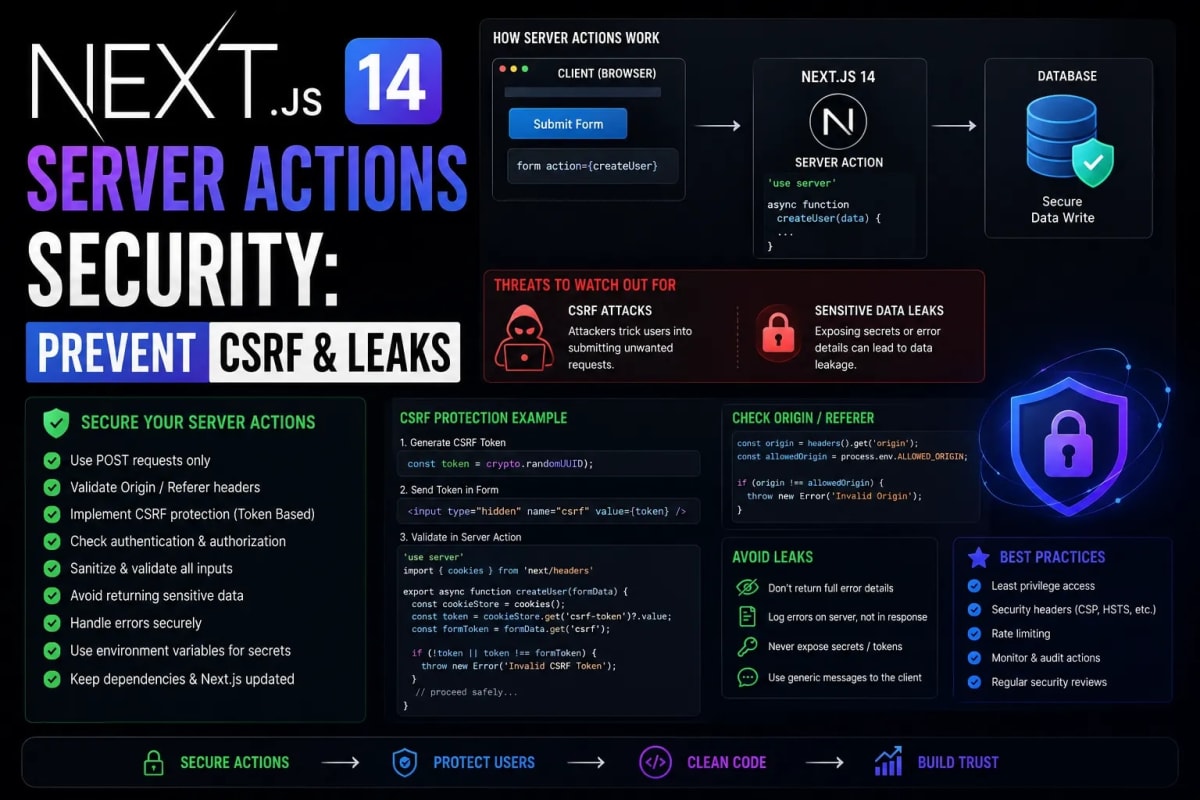
The Silent Threat: Securing Next.js 14 Server Actions Against CSRF & Data Leaks
Next.js 14 Server Actions feel like magic. By simply writing an asynchronous function and adding the "use server" directive, you can completely bypass the need to write traditional REST API routes. However, this developer convenience has birthed a massive cybersecurity crisis. Junior developers are inadvertently exposing direct database mutation functions to the public internet. Without the traditional middleware layers of an Express.js or standard API route, Server Actions are highly vulnerable to Cross-Site Request Forgery (CSRF), Broken Object Level Authorization (BOLA), and catastrophic data leaks. In this masterclass, we will construct a Zero-Trust security architecture for your Next.js 14 Server Actions.
Table of Contents
- 1. How Server Actions Actually Work (The Hidden POST Request)
- 2. The Authorization Trap: Authentication != Ownership
- 3. Defeating CSRF (Cross-Site Request Forgery) in App Router
- 4. Mathematical Input Validation with Zod
- 5. The "Hidden Return" Data Leak (Using DTOs)
1. How Server Actions Actually Work (The Hidden POST Request)
To secure a system, you must first understand its mechanics. A Server Action is not a magical portal between your React frontend and Node.js backend. Under the hood, Next.js compiles your "use server" function into an invisible, publicly accessible POST endpoint.
When a user submits a form or clicks a button tied to a Server Action, the browser sends an HTTP POST request containing a specific 'Next-Action' header. Because this endpoint is technically public, anyone with tools like Postman or cURL can trigger your Server Action from outside your website. If your function assumes it is only being called by your safe, client-side React UI, you have already been breached.
2. The Authorization Trap: Authentication != Ownership
The most common vulnerability in Next.js applications is Broken Object Level Authorization (BOLA). A developer might check if a user is logged in (Authentication) at the top of a Server Action, but fail to check if that user actually owns the data they are trying to delete or mutate (Authorization).
If a Server Action accepts an invoiceId to delete an invoice, an attacker can simply intercept the network request, change the ID to another customer's invoice, and execute the action. Your code must adopt a Zero-Trust Policy. Inside every single Server Action, you must query the database to explicitly verify that the currently authenticated session ID mathematically matches the owner ID of the target resource.
The Danger of Raw Database Types
Never pass raw MongoDB or Prisma models directly to your frontend components. If you do, you risk leaking hashed passwords or internal metadata. You must map your backend data to strict frontend interfaces. Run your safe JSON payloads through a JSON to TypeScript Converter to generate Data Transfer Objects (DTOs). This ensures your UI only receives the exact data it is allowed to display.
3. Defeating CSRF (Cross-Site Request Forgery) in App Router
CSRF occurs when a malicious website tricks a user's browser into executing an unwanted action on your site (where they are currently logged in). Fortunately, Next.js 14 has built-in protections. It compares the 'Origin' and 'Host' headers of incoming Server Action requests to ensure they originated from your domain.
However, enterprise security cannot rely on defaults alone. If you are using custom reverse proxies (like Nginx) or complex Cloudflare edge rules, these headers can be stripped or modified, breaking Next.js's native CSRF protection. Always implement custom Origin validation inside your middleware. Furthermore, if you are designing secure admin panels, use a clean, predictable UI so admins know exactly what they are clicking. Utilize a Tailwind Bento Grid Builder to create distraction-free, isolated dashboard cards that prevent accidental clicks on destructive Server Actions.
4. Mathematical Input Validation with Zod
HTML5 form validation (like required or type="email") is a UX feature, not a security feature. An attacker will bypass your frontend entirely. Because Server Actions receive raw FormData, you must parse and validate every single byte of incoming data on the server.
Do not write manual if/else checks. Use a schema validation library like Zod. By defining a strict mathematical schema (e.g., "this field must be a string, exactly 10 characters long, and contain no special characters"), you sanitize the input before it ever touches your database. If the Zod validation fails, instantly return an error object. This completely neutralizes SQL injection and NoSQL injection attempts.
5. The "Hidden Return" Data Leak (Using DTOs)
When a Server Action successfully completes, it often returns data back to the client to update the UI. A catastrophic mistake is returning the result of a database query directly. For example, returning const user = await User.findById(id) might send the user's password hash, reset tokens, and billing address to the browser's Network tab, even if you only display their username on the screen.
You must implement Data Transfer Objects (DTOs). A DTO is a stripping function that takes the raw database object and creates a new object containing only the non-sensitive fields. Never trust React to hide data. If it is sent over the network, it is public. By strictly enforcing DTO returns on all Server Actions, you ensure airtight data privacy.
Conclusion: Engineering a Zero-Trust Architecture
Next.js 14 Server Actions are an incredible leap forward in developer velocity, but velocity without safety is just a faster way to crash. By understanding that Server Actions are public APIs, validating every input with Zod, enforcing strict Ownership Authorization, and stripping outgoing data with DTOs, you can build a military-grade backend. Treat every incoming request as if it is hostile, and your application will remain unbreakable.
Frequently Asked Questions
Can I use Server Actions for GET requests (fetching data)?
While technically possible, it is highly discouraged. Server Actions are designed exclusively for mutations (POST requests). Using them for data fetching bypasses Next.js caching mechanisms and can lead to severe performance and security bottlenecks. Use standard Server Components for fetching.
Do I still need traditional API routes in Next.js 14?
Yes, you still need API routes (Route Handlers) for third-party webhooks (like Stripe or GitHub), public REST APIs that other apps will consume, and returning non-HTML data streams (like XML sitemaps or dynamic images).
How do I rate-limit a Server Action?
Because Server Actions do not pass through standard API middleware in the same way, you should implement rate-limiting at the Edge using a tool like Upstash Redis, or explicitly call a rate-limiting utility function at the very top of your Server Action block.
Does Next.js encrypt the data sent to a Server Action?
Next.js relies on standard HTTPS (TLS) to encrypt the payload in transit. However, the data is stored in plain text inside the browser's memory and the server's RAM. Never pass sensitive keys as arguments from the client to the server.
What is the 'taint' API in React/Next.js?
React introduced the 'taint' API (experimental) to prevent sensitive objects (like passwords or API keys) from accidentally being passed to Client Components. It acts as a safety net, throwing an error if a developer tries to return a 'tainted' object from a Server Component or Action.
Tagged in
Continue Reading
All Articles


Level Up Your Workflow
Free tools mentioned in this article
Unix Timestamp Converter
Convert Unix timestamps to readable dates and back instantly. View the current epoch time, convert any timestamp, and see results in any timezone.
LLM API Cost Calculator
Compare LLM API pricing across 18 models GPT-4o, Claude Sonnet 4, Gemini 2.5 Pro, DeepSeek, Mistral and more. Calculate monthly API costs, count tokens live, and convert to 7 currencies. Free, instant, no signup.
PX to EM Converter
Convert pixels to em and em to px with customizable parent font size. Free, instant, local calculation, copy-ready CSS snippets & Tailwind classes.
JWT Decoder & Verifier
Decode, parse, and verify JWT (JSON Web Tokens) securely in your browser. Validate claims and debug authentication payloads instantly with zero server logs.