
How to Build a Micro-SaaS in 2026: The Solo Founder's Complete Playbook
Author
Muhammad Awais
Published
May 13, 2026
Reading Time
14 min read
Views
21.1k
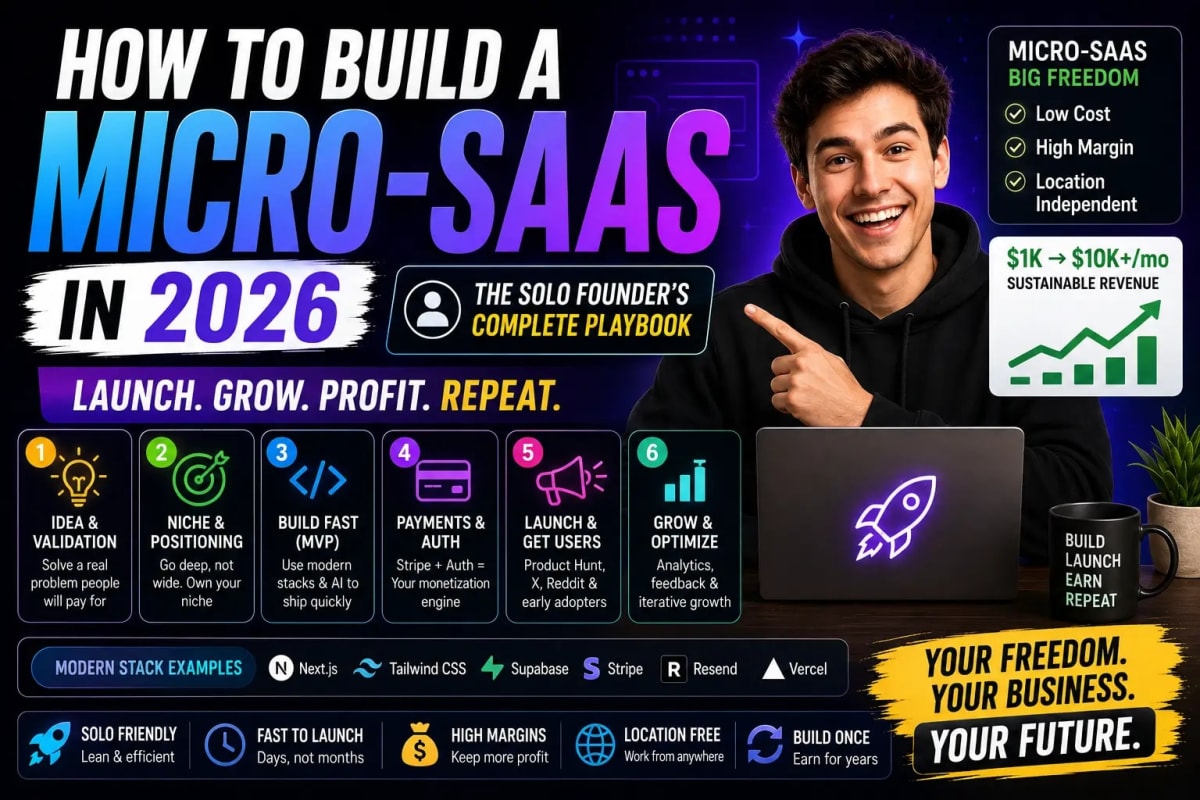
In 2026, a single developer can build, launch, and scale a software business to $10,000 MRR without a co-founder, a VC check, or a team. This is not an exaggeration. It is happening right now at a scale that would have been impossible five years ago. The combination of AI-assisted development, no-infrastructure-management deployment platforms, and a global market hungry for niche software solutions has made the solo micro-SaaS model the most realistic path to financial independence for developers that has ever existed. This guide breaks down exactly how to do it in 2026, from picking the right idea to your first paying customer.
What Is a Micro-SaaS and Why 2026 Is the Best Year to Build One
A micro-SaaS is a small, focused software product built and operated by one person or a very small team, targeting a specific niche, and generating recurring subscription revenue. It is not trying to be the next Salesforce. It is trying to solve one specific, painful problem for a specific group of people who are willing to pay monthly to have it solved.
The difference between 2026 and every previous year is the development leverage available to a solo founder. What used to take a team of four engineers six months to build can now be shipped by one developer in three to six weeks using AI-integrated IDEs, managed database platforms, and serverless deployment that scales automatically. The engineering moat that once protected large SaaS companies from solo competitors has largely collapsed. The competitive advantage now belongs to whoever finds the best niche and ships the most focused solution, not whoever has the largest engineering team.
The numbers support the opportunity. The global SaaS market is projected to reach $908 billion by 2030. Small, focused tools consistently outperform bloated all-in-one platforms in customer satisfaction scores because they do one thing exceptionally well. And subscription fatigue aside, people pay for software that saves them time, makes them money, or solves a problem they encounter every single week. Your job is to find that problem in a niche you understand.
Finding a Micro-SaaS Idea That Actually Has Legs
The graveyard of failed micro-SaaS products is full of tools built for problems nobody actually had. The validation step is not optional. The fastest and most reliable way to find a real problem is to go where complaints live: niche subreddits, product review sites like G2 and Capterra, Twitter or X threads where people vent about their workflows, and Slack communities for specific industries or job functions.
What you are looking for is a recurring complaint about an existing tool that is too expensive, too complicated, or too general. "I wish [existing tool] could just do X without me needing to set up the whole platform" is a golden signal. That gap between what someone wants and what they are currently paying for or cobbling together manually is where your micro-SaaS lives.
The best micro-SaaS ideas in 2026 have four characteristics. They solve a problem for a group of people who already spend money on software (this tells you they have a budget and take tools seriously). The problem recurs weekly or daily, which justifies a subscription rather than a one-time purchase. The solution is scoped tightly enough that you can build a working version in under four weeks. And the niche is specific enough that large competitors are unlikely to build exactly this feature as their main product.
Some categories that are producing strong results in 2026: AI-powered workflow automation for specific industries (legal, real estate, healthcare admin), niche analytics tools that pull data from platforms large analytics tools ignore, developer utilities that save recurring time on repetitive tasks, content operations tools for creators and small media teams, and integration layers that connect two popular platforms that do not talk to each other natively.
The Tech Stack That Makes Solo Building Realistic
The stack you choose determines how fast you can move and how much operational overhead you carry. For a solo micro-SaaS founder in 2026, the goal is maximum velocity with minimum infrastructure management. Every hour you spend on DevOps is an hour you are not spending on features or customer conversations.
The stack that most solo founders are converging on: Next.js as the full-stack framework (handles frontend, API routes, server actions, and authentication under one roof), MongoDB Atlas or PlanetScale for the database (fully managed, scales automatically, no server to maintain), Vercel or Railway for deployment (push-to-deploy, automatic scaling, zero server configuration), Stripe for billing (the industry standard, handles subscriptions, trials, and invoicing), and Clerk or Auth.js for authentication (implementing auth from scratch is a time sink and a security liability for solo builds).
The beautiful thing about this stack is that you can get from zero to a deployed, billing-enabled application with user authentication in a weekend. We have a detailed breakdown of how to run the entire stack for free in the early stages in our guide on building a zero-dollar SaaS stack with Next.js and MongoDB, which covers exactly what free tiers to use and when to start paying for infrastructure.
How to Validate Before You Build Anything
The single most common mistake first-time micro-SaaS founders make is spending six weeks building a product before talking to a single potential customer. This is backwards. Validation should happen before you write a line of production code, and it should involve real conversations with real people who have the problem you are solving.
The fastest validation method that works in 2026 is the landing page test. Build a one-page site that clearly describes the problem you are solving and the solution you are offering. Include a price. Add a waitlist or early-access sign-up. Then drive targeted traffic to it using communities where your target audience lives — relevant subreddits, LinkedIn posts, Twitter threads, niche newsletters. If people give you their email address for a product that does not exist yet, that is a strong signal. If nobody signs up after 200 targeted visitors, that is also a signal, and it cost you a weekend instead of two months.
Even better than email signups are pre-sales. If you can get even three to five people to pay a discounted early-access price before the product is built, you have eliminated almost all of the product-market fit risk. This feels uncomfortable before you have anything to show, but it is the most honest test of whether the problem is real and the price is acceptable. People who pay before the product exists are your first believers, and they will give you the most direct, useful feedback you will ever receive.
Pricing Your Micro-SaaS: The Most Important Decision You Will Make
Most solo founders under-price their products. Significantly. The psychological discomfort of charging real money for something you built yourself leads to pricing that is too low to build a sustainable business but not low enough to drive the volume needed to compensate. The result is a product that generates some revenue but not enough to justify the ongoing maintenance and support time it consumes.
The benchmarks that work for micro-SaaS in 2026: if your tool saves someone four hours a month, pricing it at $15 to $29 per month is a reasonable value exchange. If it saves someone 10 hours a month or generates them leads or revenue directly, $49 to $99 per month is defensible. B2B tools serving teams or businesses can go significantly higher because the value delivered is organizational rather than individual. Never price based on how long it took you to build. Price based on the value it delivers to the customer.
The free tier question comes up in every micro-SaaS discussion. The answer is nuanced. A free tier that is genuinely useful drives organic word-of-mouth and SEO traffic. A free tier that is too limited creates frustration rather than conversion. The model that works best for most micro-SaaS products is a free plan with a meaningful usage limit or feature gate that makes the paid plan an obvious next step once the user has seen the value. We break down exactly how this dynamic plays out in our piece on why free tools make more money than paid-only SaaS.
Growing a Micro-SaaS Without a Marketing Budget
The growth playbook for bootstrapped micro-SaaS in 2026 is almost entirely organic. Paid acquisition at early stage is a money pit unless you have already figured out your conversion funnel and you know exactly what a customer is worth over their lifetime. Most early-stage solo founders have not figured this out yet, and they should not be spending on ads.
Organic growth comes from three places: SEO content that attracts the exact people who have the problem you solve, community presence in the spaces where those people already spend time, and word-of-mouth from customers who are genuinely delighted by how well your product solves their problem. All three require consistency and patience, but they compound over time in a way that paid acquisition never does.
The SEO strategy that works best for micro-SaaS is programmatic: building a library of pages that target the long-tail search queries your potential customers are typing. These are usually problem-specific searches rather than category searches. Someone looking for "how to automatically move Notion tasks to Asana when status changes" is far more likely to convert than someone searching "task management software." Targeting the specific pain point beats targeting the category every time. Our guide on generating thousands of SEO pages programmatically with Next.js covers the technical implementation of this strategy in detail.
Community-led growth is underrated and underused. Being genuinely helpful in two or three communities where your target users live, without spamming or self-promoting aggressively, builds the kind of trust that converts at a much higher rate than any ad. Share useful content. Answer questions. Build in public. Document your journey. People buy from people they trust, and trust is built over time through consistent, genuine contribution.
Adding AI Features That Users Actually Pay For
In 2026, users expect AI capabilities in the tools they pay for. But the implementation matters enormously. AI features that feel bolted on as marketing — "now with AI!" buttons that produce generic output — actively damage user trust. AI features that genuinely automate something tedious or surface something useful the user could not have found on their own create real lock-in and justify premium pricing.
The AI feature pattern that creates the most value in micro-SaaS is context-aware automation: AI that understands the user's specific data, their specific history, and their specific workflow, and takes meaningful action on it. This is different from generic AI chat wrappers. Building this kind of context-aware intelligence requires retrieval-augmented generation (RAG) and vector database integration, which sounds intimidating but is now well within reach of a solo Next.js developer. If you want to go deep on the implementation, our guide on building context-aware AI into Next.js with RAG and vector databases is the most practical starting point available.
The cost management side of AI features is a real constraint for solo founders. API costs at scale can eat margin quickly if you are not thoughtful about caching, prompt efficiency, and where you run inference. The founders who are building profitable AI-powered micro-SaaS are not the ones using AI everywhere — they are using it precisely, where it delivers clear user value, and designing their pricing to make the economics work at scale.
What the Path to $5K MRR Actually Looks Like
Let's make this concrete. At $49 per month, you need 102 paying customers to hit $5,000 MRR. At $29 per month, you need 173. These are not large numbers. They are the kind of numbers you can reach in six to twelve months with a focused product in a real niche, consistent organic content, and genuine community engagement.
The milestones that actually matter in sequence: first, get five people to give you their email on a landing page before you build anything. Second, get three people to pay you something — even a small amount — before the product is finished. Third, ship a working MVP and get to ten active users who use it at least once a week. Fourth, talk to all ten of them on a call, understand what they value and what is missing, and use that information to build the next month of roadmap. Fifth, focus obsessively on reducing churn — a product that keeps its customers grows faster than one that constantly acquires and loses them.
The founder who reaches $5K MRR in 2026 is not the one who built the most features. It is the one who talked to the most customers, shipped the most consistently, and stayed focused on a specific problem for a specific audience long enough to build real word-of-mouth. The temptation to pivot, add features, or chase a broader market before you have real product-market fit is the thing that kills most micro-SaaS attempts before they get traction.
Frequently Asked Questions
How much does it cost to start a micro-SaaS in 2026?
You can start with almost nothing. The core stack — Next.js on Vercel, MongoDB Atlas, Clerk for auth, and Stripe for billing — all have free tiers that are more than sufficient for the first 50 to 100 users. Your real investment in the early stage is time, not money. Most solo founders get to their first $1K MRR spending less than $50 per month on infrastructure.
Do I need to be a full-stack developer to build a micro-SaaS?
In 2026, not necessarily. AI-assisted development has significantly lowered the technical floor. That said, having at least a working understanding of how web applications are structured, how APIs work, and how databases store data will dramatically improve your ability to build something stable enough to charge for. Pure no-code tools are an option for simpler products, but they come with platform risk and customization ceilings that matter as you scale.
How long does it take to build a micro-SaaS MVP?
With AI-assisted development and a modern stack, a focused MVP can be built in two to four weeks by a single developer. The key word is focused. An MVP that tries to solve five problems will take five times as long and will be worse at solving all of them. Define the single core action your product needs to do, build that exceptionally well, and ship. Everything else comes after you have paying users.
What are the best micro-SaaS niches in 2026?
The most promising categories right now are AI-powered automation for specific professional workflows (legal, medical admin, real estate, e-commerce operations), niche analytics tools for platforms that underserve their data API users, developer productivity utilities that save recurring time, content operations and repurposing tools for creators and small media teams, and integration middleware for popular platforms that do not natively connect. The pattern across all of them: they serve people who already pay for software and who have a clearly recurring pain.
Is micro-SaaS still worth building in 2026 with so much competition?
More than ever. The market has grown larger than the competition has grown. There are more SaaS buyers in 2026 than there have ever been, including in markets and industries that were barely digitized five years ago. Competition at the niche level is still relatively thin because most founders chase the same obvious categories. The opportunity is in the niches that feel too small to be interesting to larger players but are perfectly sized for a solo founder to build a $5K to $20K MRR business that runs with minimal overhead.
Tagged in
Continue Reading
All Articles


Level Up Your Workflow
Free tools mentioned in this article
SQL Query Validator
Validate and format SQL queries instantly MySQL, PostgreSQL, SQLite & SQL Server. Free online SQL query checker with detailed error messages. No signup needed.
PX to REM Converter
Convert px to rem and rem to px instantly - bidirectional, custom base font size, bulk converter, and CSS snippet output. Free, no signup.
Markdown to HTML Converter
Convert Markdown to clean HTML instantly with live preview. Supports GitHub Flavored Markdown, tables, code blocks, and task lists. Free and browser-based.
Cron Job Expression Generator & Explainer
Generate cron expressions visually and instantly translate any cron schedule into plain English. Includes GitHub Actions, Vercel, and AWS presets.