
The AI Wrapper Era is Dead: Building Context-Aware AI with Next.js & RAG
Author
Muhammad Awais
Published
May 12, 2026
Reading Time
6 min read
Views
174
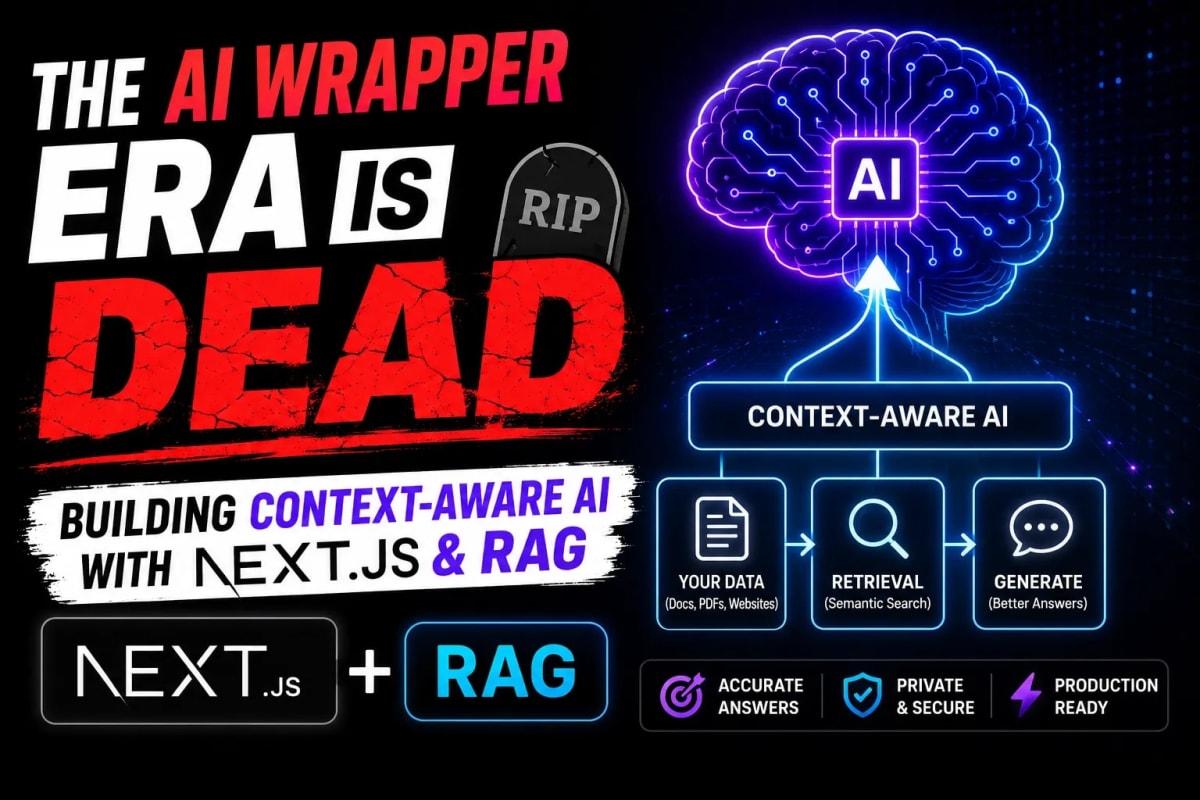
The gold rush of thin 'AI Wrappers' is officially over. Users demand smarter, context-aware applications. Learn enterprise-level AI architecture by integrating RAG (Retrieval-Augmented Generation), Vector Databases, and the Vercel AI SDK into your Next.js applications.
The Death of the "AI Wrapper"
In 2023 and 2024, thousands of indie hackers made quick money by building "AI Wrappers" simple user interfaces built on top of the OpenAI API. You typed a prompt, the app sent it to ChatGPT, and returned the text. Fast forward to 2026, and this business model is completely dead. Consumers are educated. They already have ChatGPT, Claude, and Gemini on their phones. They will not pay you $10 a month for a simple prompt-generation tool. To survive and build profitable AI software today, your application must possess something the foundational models do not have: Proprietary Context. This is where Retrieval-Augmented Generation (RAG) and Vector Databases become the most important skills for a modern Full Stack Developer.
What is RAG? (Retrieval-Augmented Generation)
Imagine taking an incredibly smart university professor (the LLM) and asking them specific questions about the internal HR policies of your specific company. The professor is a genius, but they will fail the test because they haven't read your company's private handbook. They will start guessing (Hallucination).
RAG is the process of giving that professor an open-book test. Instead of just sending the user's question to the AI, we first search our own private database for documents related to the question. We retrieve those documents, attach them to the prompt, and say to the AI: "Here is the user's question, and here are three pages from our private handbook. Answer the question using ONLY the information in these pages." This guarantees 100% accurate, domain-specific AI responses without the multi-million dollar cost of fine-tuning a model.
The Modern AI Architecture: Vector Databases
How do we quickly find the right documents to give to the AI? Traditional SQL databases (like PostgreSQL using LIKE '%keyword%') are terrible at this. They only match exact words. If a user asks about "employee vacation," a SQL database won't find the document titled "Staff Time-Off Policy" because the words don't match.
This is why Vector Databases (like Pinecone, Qdrant, or Supabase pgvector) are mandatory for modern AI apps. We run our private documents through an Embedding Model, which converts the text into arrays of thousands of numbers (vectors) representing the semantic meaning of the text. When the user asks a question, we convert their question into a vector too. The Vector Database then performs a mathematical "Similarity Search" to find documents that mean the same thing, even if they use completely different vocabulary.
The Vercel AI SDK Advantage
If you are building this in Next.js, the Vercel AI SDK is your best friend. It abstracts away the massive headache of managing streaming API responses and complex UI states. Furthermore, it introduces Generative UI. Instead of the AI just returning plain text, you can command the AI to return structured React components (like a live interactive chart or a dynamic Bento Grid Layout) directly into the chat stream.
Structuring Data for LLMs: The JSON Mandate
One of the hardest parts of building AI applications is forcing the LLM to return data in a format your application can actually use. If you ask an AI to generate a list of users, and it returns a conversational string like "Here is the list you asked for: 1. John Doe...", your frontend React code will crash. You cannot map over a conversational string.
Senior developers use strict "Structured Outputs" (forcing the AI to return raw JSON). However, defining the schema for this JSON can be tedious. A massive productivity hack is to design your desired TypeScript interface first, compile it into a dummy JSON object, and then use a robust JSON to TypeScript Converter to ensure your types are perfectly aligned. You then inject this strict schema into your system prompt, mathematically guaranteeing the AI returns parsable data.
Controlling API Costs (The Client-Side Embedding Hack)
If you are an indie hacker, calling OpenAI's embedding API every single time a user types a query will drain your bank account rapidly. You must optimize.
Modern Next.js developers are shifting towards local, client-side embeddings. By utilizing libraries like Transformers.js, you can download a lightweight embedding model directly into the user's browser via WebAssembly (Wasm). Just as we discussed in our Client-Side Processing Guide, calculating the semantic vectors on the user's local CPU means your server does zero work. You only call the paid LLM API for the final generation step, cutting your AI infrastructure costs by up to 70%.
Conclusion: Build Moats, Not Wrappers
The barrier to entry for building software has never been lower, which means the barrier to success has never been higher. Do not build thin AI wrappers. Dive deep into the architecture. Master Vector Databases, implement robust RAG pipelines, and utilize the Next.js App router to deliver streaming, contextually brilliant AI experiences. Proprietary data and seamless UX are the only true moats left in the AI era. Start building yours today.
Frequently Asked Questions
Is it expensive to run a Vector Database for a side project?
Not anymore. While enterprise vector databases used to be costly, platforms like Pinecone offer generous Serverless free tiers. Alternatively, if you are already using Supabase (PostgreSQL), you can simply enable the 'pgvector' extension to get powerful vector search completely for free on your existing database.
How do I prevent my AI from hallucinating?
Hallucinations happen when the AI tries to guess missing information. The fix is a combination of RAG and strict System Prompts. You must inject a prompt that says: 'If the answer is not explicitly found in the provided context documents, you must reply strictly with: I do not have enough information to answer that.' This breaks the LLM's natural desire to please the user with a guessed answer.
Do I need to learn Python to build AI apps?
In 2026, no. While Python is still the king of AI model training, the application layer is dominated by JavaScript and TypeScript. Libraries like LangChain.js, LlamaIndex.ts, and the Vercel AI SDK allow you to build enterprise-grade RAG applications entirely within your Next.js / Node.js ecosystem.
What is Chunking in RAG?
LLMs have a context window limit (how much text they can read at once). If you have a 500-page PDF, you cannot send the whole thing. 'Chunking' is the process of breaking that massive PDF into smaller, overlapping paragraphs (chunks) before saving them to your Vector Database. This ensures you only retrieve and send the exact 2 or 3 paragraphs relevant to the user's question.
Tagged in
Continue Reading
All Articles
Level Up Your Workflow
Free tools mentioned in this article
Image Resizer & Compressor
Compress image to 20KB, 50KB, or 100KB online free instantly reduce image size in KB for government forms, exams (UPSC, SSC, FPSC, NTS), passport photos, and more. Works entirely in your browser.
Tailwind Class Sorter
Sort Tailwind CSS classes instantly using Prettier's official order. Paste plain classes, HTML, or JSX get clean, sorted output in one click. Free, no signup.
Stripe & PayPal Fee Calculator
Calculate the exact Stripe and PayPal transaction fees for US and UK markets. A free developer tool to estimate SaaS payouts, merchant costs, and revenues.
SVG to JSX / TSX Converter
Transform raw SVG code into production-ready React (JSX/TSX) components. Features camelCase mapping, Tailwind support, and TypeScript prop generation.